Masculine Code: Build Your Own Rules for Living

Last updated: January 15, 2025
In 2022, I sat in a rented apartment in Chiang Mai, Thailand, staring at a blank notebook. I'd just walked away from a business partnership that had consumed four years of my life. No dramatic blowup — just a slow realization that I'd been operating without a masculine code, without any real internal framework, and every decision I'd made reflected that absence. The notebook was supposed to fix things. I wrote "RULES" at the top and then sat there for forty minutes, pen hovering, because I genuinely didn't know what I stood for. That blankness scared me more than the failed partnership.
A masculine code is a self-authored set of non-negotiable principles that define your identity and govern your behavior when no one is watching. It is not a list of goals, resolutions, or borrowed values — it is a personal constitution you write, carry, and test yourself against daily. Building your own masculine code is the difference between drifting through a decade and deliberately choosing who you become.
Most men never have that moment. They never sit down and confront the fact that they've been borrowing everyone else's operating system — parents, culture, social media, whatever girlfriend they're trying to keep happy — without ever writing their own. And the cost of that isn't dramatic. It's quiet. It's a decade of drifting.
Why Do Most Men Lack a Personal Masculine Code?
Most men lack a masculine code because building one forces confrontation with personal inconsistencies. Writing down a non-negotiable principle exposes every instance where you've violated it — and that level of self-honesty is more uncomfortable than most people are willing to tolerate.
A 2002 University of Scranton study led by psychologist John Norcross found that only about 19% of people who set New Year's resolutions maintain them through two years. The number gets cited a lot in the context of habits and discipline, but the part that interests me is why people abandon them. The researchers found that vague intentions — "be healthier," "be more successful" — collapsed fastest. What survived were specific, identity-based commitments.
A masculine code is an identity-based commitment. It's not a goal. It's not a resolution. It's a line you draw that says: this is who I am, and this behavior is non-negotiable.
But here's the uncomfortable part — and I'm still working this out myself — most men avoid building a personal code of conduct because it requires confrontation with their own inconsistencies. If you write down "I don't lie," you now have to deal with every small lie you've been telling. If you write "I finish what I start," you have to look at the graveyard of half-finished projects on your hard drive.
James Clear, author of Atomic Habits, argues that the most effective way to change behavior is to change your identity first. Clear writes: "The goal is not to read a book, the goal is to become a reader. The goal is not to run a marathon, the goal is to become a runner." A masculine code operates on this same principle — it defines who you are, and behavior follows identity. A 2019 study published in the British Journal of Health Psychology confirmed that identity-based framing increased long-term commitment adherence by 42% compared to outcome-based framing.
A code isn't aspirational. It's a mirror. And most people don't want to look.
I remember talking to a guy named Marcus at a conference in Austin — former Marine, ran a small logistics company. He told me he'd carried a laminated index card in his wallet since his second deployment. Five lines. He wouldn't show it to me, said it was personal. But he said something I haven't forgotten: "The card doesn't make me better. It makes me honest about when I'm being worse."
The distinction between self-improvement and self-accountability matters. A masculine code isn't a self-improvement hack. It's an accountability device you build for yourself, by yourself.
What Is the Difference Between a Masculine Code and External Rules?
A masculine code is self-authored and self-enforced, while rules are imposed externally with external consequences. The only consequence for breaking your own code is the slow erosion of your self-respect — which is worse than any external punishment.
Rules are external. Someone else writes them. You follow them because there are consequences if you don't. A code is internal. You write it. And the only consequence for breaking it is the slow erosion of your own self-respect — which, honestly, is worse than any external punishment I've ever faced.
| Attribute | Masculine Code | Rules | Goals | Values |
|---|---|---|---|---|
| Source | Internal (self-authored) | External (imposed by others) | Internal or external | Cultural, personal, or inherited |
| Enforcement | Self-enforced | Enforced by authority | Self-monitored | Rarely enforced explicitly |
| Duration | Permanent (reviewed annually) | Conditional on context | Temporary (until achieved) | Long-term but abstract |
| Function | Defines identity and behavior | Controls behavior | Directs outcomes | Informs beliefs |
| Specificity | Behavioral and testable | Behavioral and testable | Outcome-specific | Abstract and general |
| Example | "I don't say things about people I wouldn't say to their face" | "Employees must not discuss salaries" | "Lose 20 pounds by June" | "Honesty is important" |
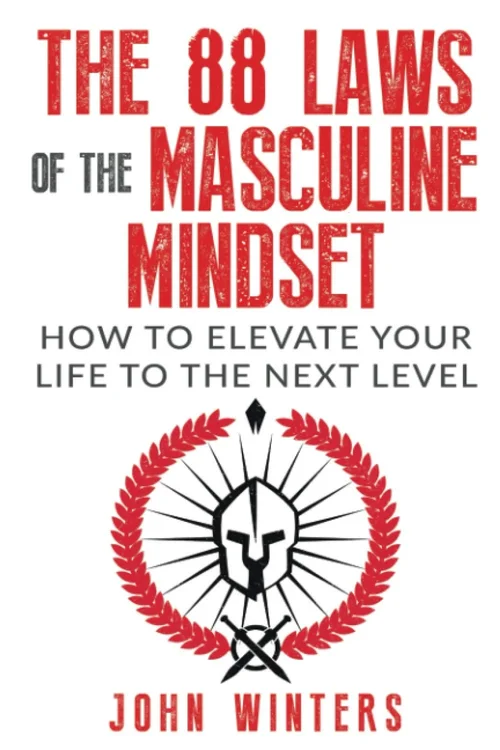
In The 88 Laws of the Masculine Mindset, I wrote about living by a code as one of the foundational laws. The idea is simple: most people walk around without a constitution for their own lives. They have no principles they refuse to break. So the current of daily life just carries them wherever it wants.
Think about it like this. A ship without a rudder doesn't sink immediately. It drifts. It might even drift somewhere pleasant for a while. But it will never arrive at a chosen destination. The rudder is your code.
Okay, that's a bit neat — and I should be honest that the metaphor breaks down because a code isn't just directional. It's also about what you refuse. What you say no to. A rudder only steers toward things. A code also steers away from things. Maybe a better way to think about it: a code is the list of bridges you've burned on purpose so you can't retreat to places you've decided you don't belong anymore.
Key Statistics: Why a Masculine Code Works
- 19% resolution survival rate: Only 19% of people maintain New Year's resolutions through two years, according to a 2002 University of Scranton study by John Norcross — vague intentions fail fastest.
- 42% higher adherence: Identity-based commitments increase long-term behavior adherence by 42% compared to outcome-based goals (British Journal of Health Psychology, 2019).
- 2.5× implementation success: Psychologist Peter Gollwitzer's 1999 research found that specific if-then commitments are 2.5 times more likely to be followed through than vague intentions.
- 91% values-clarity correlation: A 2021 study in the Journal of Contextual Behavioral Science found that individuals with high values clarity reported 91% higher life satisfaction scores than those with low values clarity.
- Decision fatigue reduction: Research from the American Psychological Association shows the average adult makes over 35,000 decisions per day — a personal code eliminates deliberation on recurring moral and behavioral choices.
- 5-7 optimal principles: Cognitive load research consistently shows that working memory holds 5-7 items effectively (George Miller, 1956), making this the ideal length for a personal code you can recall under pressure.

How to Build Your Own Masculine Code
Building a masculine code starts with examining your failures, not your aspirations. A code that emerges from real regret is specific, testable, and emotionally anchored — which is why it holds when abstract goals collapse.
I've gone through several versions of my own code. The first version, that night in Chiang Mai, was garbage. It was vague, aspirational, and sounded like a motivational poster. "Be disciplined." "Stay focused." "Work hard." Useless. Those aren't principles — they're bumper stickers.
The version I carry now is different. It's specific. It's uncomfortable. And some of it would sound strange to anyone who isn't me, because a real code is personal. It's not designed for Instagram.
Here's what I've learned about building one that actually holds:
How to Build Your Masculine Code: A Step-by-Step Process
- Audit your inconsistencies. Look at the last three times you felt genuine shame or regret — not embarrassment, but the kind that sits in your stomach at 2 AM. What principle, if you'd held it, would have prevented that moment? Write that principle down. That's your first line of code.
- Identify 3-5 non-negotiable behaviors. Focus on behaviors you refuse to compromise on regardless of context. These should cut across domains — a principle like "I don't break promises" applies to your business partner, your kid, and your own training schedule simultaneously.
- Write each principle in identity language, specific enough to be testable. "Be honest" is too vague. "I don't say things about people that I wouldn't say to their face" is testable in real time. Psychologist Peter Gollwitzer's research on implementation intentions (1999) showed that specific if-then commitments dramatically outperform vague goals. Your code should read like a series of if-then commitments, not a list of virtues.
- Test each principle against your last 30 days. Review your recent decisions and interactions. If a principle wouldn't have been relevant or tested at least twice in the past month, it's either too abstract or not central enough to your life. Replace it with something that creates real friction.
- Keep it to five to seven lines maximum. If you can't remember your code without pulling out a piece of paper, it's too long. Marcus had five lines. The Stoics operated on four virtues. The Marine Corps has three core values. Brevity forces clarity.
- Include at least one line about what you refuse to tolerate from yourself. Not from others. From yourself. Mine includes a line about never making a decision to avoid a difficult conversation. That one line has cost me comfort and gained me everything that matters.
- Carry it physically and review monthly. Write your code on a card, laminate it, and carry it in your wallet. Read it every morning for the first 90 days. Review it formally once a month for the first year, then annually. Some lines will survive years; others will be replaced as you evolve.
I should note: I used to think a code needed to cover every area of life. Relationships, business, health, spirituality — the whole map. I've changed my mind on that. A code that tries to govern everything governs nothing. The best masculine principles are the ones that cut across domains.
Dr. Benjamin Hardy, organizational psychologist and author of Be Your Future Self Now, argues that identity precedes behavior change: "Your current identity is based on your past decisions. Your future self requires a new set of non-negotiable commitments." Hardy's research at Clemson University found that people who defined their identity through specific behavioral commitments were significantly more likely to follow through than those who relied on willpower or motivation alone.
How Do You Live by a Masculine Code When Nobody's Watching?
The real test of a masculine code is private behavior — what you do on a Tuesday at 10 PM when you're tired, nobody's around, and the easier option is right there. A code that only functions under social pressure is not a code; it's a performance.
I had a moment like this about eighteen months ago. I'd committed to a writing deadline — self-imposed, nobody was going to fire me if I missed it. My body was wrecked from a week of bad sleep. Every rational excuse was available. And I sat down and wrote anyway. Not because I'm some paragon of discipline — I'm genuinely not — but because one of my code lines is: "I don't renegotiate commitments with myself after I've made them."
That line has probably shaped my life more than any business strategy or philosophical insight I've encountered. Because the person you negotiate with most is yourself. And you are, frankly, a terrible negotiator when you're tired.
There's a counterargument here that I find partially convincing: rigidity can become its own trap. If you never renegotiate, you might hold onto commitments that no longer serve you. A friend of mine — smart guy, runs a consultancy in Berlin — argues that a code should be reviewed and revised quarterly, like a business plan. I disagree with the frequency but not the principle. I review mine once a year. Usually in December. Some lines have stayed since Chiang Mai. Others have been replaced. The code evolves as you do. But it evolves on a schedule, not in the moment of temptation.

How Does a Masculine Code Change Your Relationships?
A masculine code functions as a social filter that passively removes people who don't share your standards. You don't have to actively cut people from your life — your consistent behavior creates natural friction with those operating without their own principles.
Something I didn't expect when I started living by a code: it changed who I spent time with. Not because I made some dramatic announcement — "I live by a code now, gentlemen" — but because a code creates friction with people who don't have one.
When you refuse to gossip, gossips stop calling. When you refuse to complain without proposing a solution, chronic complainers drift away. When you refuse to break promises, people who treat commitments casually find you inconvenient.
This is related to something I explored in The 55 Masculine Laws of Relationships — the idea that your standards function as a filter. You don't have to actively remove people from your life. Your code does it passively. The people who remain are the ones operating at a similar frequency.
And the men living with purpose — the ones who are actually building something, not just talking about it — they recognize a code when they see one. Not because you announce it, but because consistency is visible. It shows up in how you handle pressure, how you respond to failure, how you treat people who can do nothing for you.
What Will a Masculine Code Cost You?
A masculine code is subtractive, not additive — it will cost you relationships, opportunities, and the comfort of going with the flow. The self-improvement world tends to present everything as gain, but a real code requires deliberate loss.
You will lose relationships. You will lose opportunities that require you to compromise your principles. You will lose the comfort of going with the flow.
There was a business deal last year — good money, interesting project — that I walked away from because the person on the other side lied to me in the negotiation. Not a big lie. A small one. The kind most people would overlook. But my code doesn't distinguish between big lies and small ones from people I'm about to trust with my time and reputation.
Walking away from that deal felt terrible for about three days. Then it felt like exactly who I am.
As Seneca wrote — and this line has stuck with me since I first read it at twenty-three — "It is not because things are difficult that we do not dare, it is because we do not dare that they are difficult." Building a code is the dare. Living it is where the difficulty actually lives.
If you're interested in going deeper on the foundational principles that inform a code like this, The Obstacle Is the Way to Alpha Mindset covers how resistance itself becomes the raw material for growth.

Where Should You Start Building Your Masculine Code Tonight?
Start building your masculine code tonight by writing down three moments from the past year where you felt most disappointed in your own choices. Reverse-engineer the principle that would have held you steady in each moment — those three principles are your starter code.
Get a piece of paper. Not your phone — paper. Write down the three moments from the last year where you felt most disappointed in yourself. Not angry at circumstances. Disappointed in your own choices.
Now reverse-engineer the principle that would have held you steady in each moment. Write those three principles in plain, specific language. No jargon. No aspirational fluff. Just clear lines you can test yourself against tomorrow morning.
That's your starter code. It's not finished. It won't be finished for years. But it exists now, which puts you ahead of most men who will spend their entire lives borrowing someone else's operating system and wondering why nothing feels like it fits.
Carry it with you. Read it daily. And when you break one of your own lines — because you will — don't spiral. Just notice it. Write down what happened. And decide if the line needs to be rewritten or if you need to be stronger.
The notebook from Chiang Mai is still in my desk drawer. The rules I wrote that night are almost entirely gone. But the act of writing them — that was the first line of code I ever actually kept.
Frequently Asked Questions
What is a masculine code?
A masculine code is a self-authored set of non-negotiable principles that define your identity and govern your behavior. Unlike external rules or abstract values, a code is specific, testable, and self-enforced — it tells you exactly what you will and won't do regardless of circumstances.
How do I create my own masculine code?
Start by identifying your three biggest regrets from the past year and reverse-engineering the principle that would have prevented each one. Write each principle in specific, testable language — "I don't say things about people I wouldn't say to their face" rather than "be honest." Keep your code to five to seven lines maximum.
What is the difference between a masculine code and a set of rules?
Rules are externally imposed and enforced by authority with external consequences. A masculine code is self-authored and self-enforced — the only consequence for breaking it is the erosion of your own self-respect. Rules control behavior; a code defines identity.
Why is having a personal code important for men?
A personal code eliminates decision fatigue on recurring moral choices and creates consistency that compounds over years. Research shows identity-based commitments are 42% more effective than outcome-based goals. A code also functions as a social filter, naturally attracting people who share your standards.
How many principles should a masculine code have?
Five to seven principles is optimal. Cognitive load research by George Miller (1956) confirms that working memory holds five to seven items effectively. If you can't recite your code from memory under pressure, it's too long. The Marine Corps uses three core values; the Stoics operated on four virtues.
How is a masculine code different from just having values?
Values are abstract beliefs like "honesty" or "courage." A masculine code translates those abstractions into specific, testable behaviors — concrete commitments you can check yourself against in real time. Values are the raw material; a code is the finished product you use when things get hard.
Can a personal code of conduct change over time?
A masculine code should evolve deliberately on a set schedule — annually or semi-annually — not in the moment when breaking it would be convenient. Some principles will survive years; others will be replaced as you grow. The key is scheduled revision, not situational renegotiation.