Creative Restraint is the Builder’s Hardest Art Form
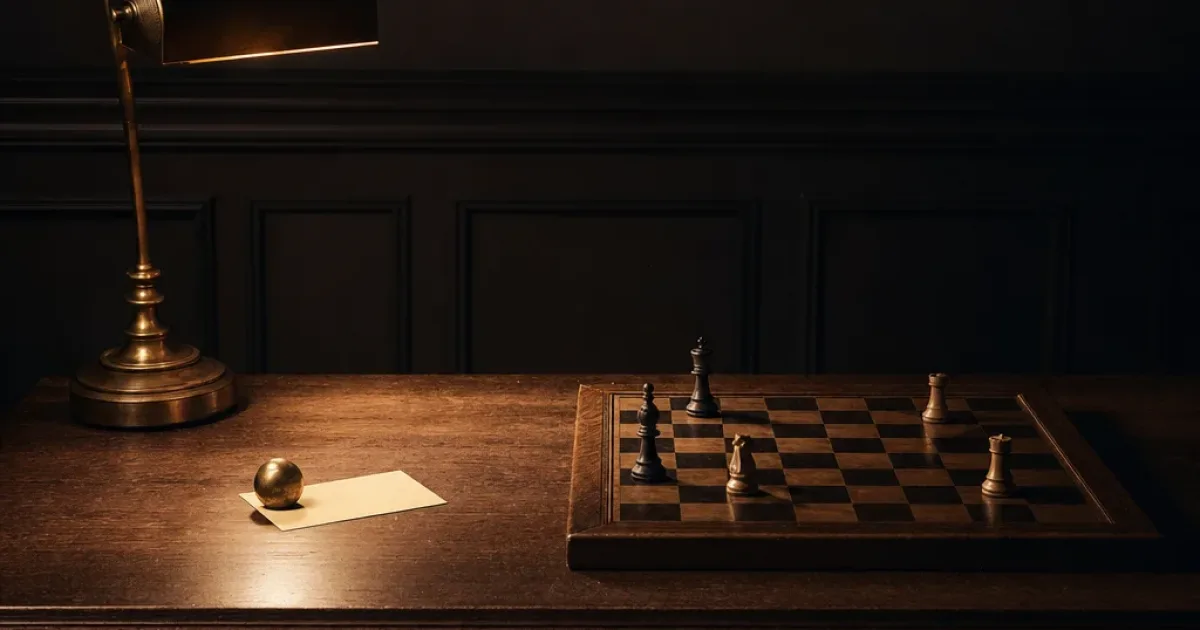
At 9:47 p.m., I was standing over a kitchen table covered in index cards, a brass thimble, two dead batteries, and a bowl of green olives I had no memory of opening, trying to decide whether Creative Restraint meant cutting the best line or refusing to add the clever one in the first place.
The lamp made the cards look theatrical. Each card carried a possible essay angle, product idea, or little business provocation. Some were good. A few were too good in that dangerous way: shiny enough to distract from the work that had already begun. I kept moving the thimble from one card to another like a tiny judge’s gavel. Ridiculous, yes. Also clarifying.
"By adopting Self Discipline and building a code of Self Discipline you can take control of your life."
— John Winters, Self-Discipline
Creative Restraint is the builder’s hardest art form because it asks us to murder abundance while abundance is still smiling at us. The thesis I’m circling is simple: creative entrepreneurship does not fail only from lack of ideas; it often fails from an inability to choose which idea deserves the room, the money, the screen, the month.
I don’t fully trust people who preach simplicity too quickly. Some work needs mess. Some discovery requires a little intellectual debris on the floor. But I’ve watched too many founders, writers, designers, and product people confuse motion with making. They add features, channels, offers, words, colors, meetings, and “community layers” until the original signal sounds like a violin inside a washing machine.
Creative Restraint is not minimalism as décor. Creative Restraint is the discipline of protecting the work from your own appetite.
What Is Creative Restraint Really Asking Us to Give Up?
What if Creative Restraint is less about doing less and more about giving up the narcotic of optionality?
Optionality feels intelligent. The modern builder loves options because options imitate freedom. Keep the extra feature. Keep the backup niche. Keep the second newsletter. Keep the fourth audience segment because, well, the market might want it. Keep everything warm.
And then the work becomes lukewarm.
I’ve done this. I used to believe range was the highest creative virtue. I wanted the business model to have wings in every direction, the essay to carry every insight, the product to solve the visible problem and three subterranean ones. There was pride in it, and not the clean kind. I mistook my refusal to choose for philosophical depth.
That belief has become harder to defend. Range without refusal becomes clutter wearing a crown.
Jay Acunzo, writing on creative freedom versus creative restraints, argues that constraints don’t suffocate creativity; they give creativity a form to push against. I like that phrasing because it doesn’t romanticize limits. A constraint is not a velvet rope. A constraint is friction, and friction is where the builder starts to discover whether the idea has legs or only perfume.
The phrase “creative freedom” has become dangerously lazy in business circles. People use it to mean “I don’t want to be edited.” They use it to mean “I want permission to sprawl.” Okay, that’s oversimplified — plenty of serious artists defend freedom for good reasons — but the entrepreneurial version of boundless creativity often becomes a financial leak.
Creative Restraint asks for four particular sacrifices:
- The sacrifice of the extra audience. A message aimed at everyone develops the posture of a mannequin.
- The sacrifice of the impressive feature. A feature can be clever and still damage the product’s promise.
- The sacrifice of the decorative idea. A sentence, slide, package, or campaign can sparkle while weakening the whole.
- The sacrifice of premature scale. More distribution can spread confusion faster than clarity.
These sacrifices sound clean on a page. In the room, they feel like loss. A founder deleting a feature from the roadmap does not feel elegant; she feels exposed. A writer cutting a paragraph does not hear angels; he hears wasted labor. A designer removing color from a system may feel, for one long minute, like personality itself has been confiscated.
Creative Restraint in design might mean reducing visual noise so a user knows where to click. Creative Restraint in writing might mean letting one scene carry the argument instead of explaining the argument until it bruises. Creative Restraint in product development might mean shipping the sharp tool before building the ecosystem around it. Same principle. Different wounds.
The wound is the evidence. If the cut costs you nothing, it probably wasn’t restraint. It was tidying.
The Builder’s Addiction to More Is Not Always Greed
The urge to overproduce is often a bid for safety, not a failure of taste.
I’m suspicious of moralizing this subject. “Just focus” is the advice of people who have forgotten how loud possibility can be when payroll, reputation, and private ambition start breathing on your neck. The founder who adds too many features may not be vain. The artist who overworks the canvas may not be undisciplined. The writer who explains the point four different ways may be afraid the reader won’t stay.
Fear is a busy editor.
Strategic focus sounds noble after the fact. Before the fact, strategic focus feels like walking past money on the ground because your hands are already full. A consultant suggests a new funnel. A customer asks for a feature. A platform rewards a new format. A competitor launches a noisy thing with a bright name. Every signal says: add.
And the builder obeys.
I’ve come to think the word “more” functions like a little sedative in creative entrepreneurship. More channels mean we don’t have to face whether the core message is dull. More offers mean we don’t have to admit the first offer lacks demand. More edits mean we don’t have to publish the piece and let silence judge it. More brainstorming means no one in the room has to say, “That’s the one, and now we must live with it.”
Some of the best business work I’ve seen came from people who treated limitation as an operating system. They didn’t merely make a smaller list. They built a boundary the team could feel. One homepage promise. One buyer. One weekly publishing rhythm. One product improvement that users would notice without being told. The constraint became a rail under the work.
I wrote about this cousin of restraint in strategic restraint as an entrepreneurial edge, and the idea keeps returning because the market keeps rewarding people who can be understood quickly. Not shallowly. Quickly. There’s a difference, and lazy marketers collapse it.
A company can be deep and still legible. A piece of software can carry serious engineering and still present one obvious next action. A painter can hide a lifetime of study inside a single quiet field of blue. The audience shouldn’t need a treasure map just to know what you’re offering.
Overproduction also protects the ego from finality. If the work is never finished, the work can never fully fail. The draft can always be “in development.” The offer can always be “evolving.” The brand can always be “expanding.” I’ve used those words. I’ve hidden inside them. And yes, sometimes evolution is real. Sometimes “expanding” is just fear wearing a blazer.
Creative Restraint improves productivity because it reduces the number of decisions that can ambush you before lunch. A writer who decides “I publish one clear argument every Thursday” has fewer doors to kick open each week. A designer who limits a visual system to two typefaces stops losing afternoons to tiny debates. A founder who refuses custom work outside the core offer protects the calendar from becoming a junk drawer.
There are tools that can enforce these limits, though tools can become another costume for avoidance. A timer can help. A Kanban board with a strict work-in-progress limit can help. A document template with a hard word count can help. Website blockers can help if your “research” keeps turning into competitive surveillance with snacks.
The tool is not the discipline. The tool is the little fence you agree not to climb before 3 p.m.
For daily creative work, I use a plain restraint exercise when the work starts swelling:
- Name the promise in one sentence. If the piece, product, or campaign cannot be named plainly, the project is still fog.
- Choose the primary verb. Decide whether the work should teach, sell, provoke, soothe, or clarify. One verb gets the wheel.
- Cut one attractive element. Remove something good, not something obviously bad. Restraint begins where taste starts to complain.
- Set a finish line before you feel ready. A deadline with a visible deliverable forces the idea to stop auditioning.
- Ask what the audience must do next. If the next action is unclear, the work has been decorated instead of designed.
That exercise is not sacred. It’s just useful. It turns Creative Restraint from an aesthetic preference into a behavior you can repeat while a dishwasher runs and your phone keeps lighting up with nonsense.
There is another layer, and it is less flattering. Many builders overproduce because they want applause from other builders. A clean product may sell better, but a complicated product looks more impressive in a founder conversation. A clear essay may reach more readers, but a dense essay signals intellectual status to peers. A simple logo may work harder in the market, but a complex brand system looks better in the case study.
Creative Restraint asks an ugly question: are you building for the person who needs the work, or for the insider who will admire the scaffolding?
When Restraint Becomes Cowardice
| Builder’s Impulse | Creative Restraint | Result |
|---|---|---|
| Add more features | Cut to the core bet | Clearer product |
| Chase every idea | Choose one strong direction | Sharper taste |
| Fill every gap | Leave useful space | Less noise |
| React to pressure | Hold the line calmly | Stronger work |
A designer removes every strange element from a brand identity because the client says “clean,” then the final work looks like five hundred other pitch decks dying politely in beige.
That case complicates the romance of Creative Restraint. Restraint can become a respectable name for timidity. A founder can cut so much risk from an idea that the offer arrives pre-bored. A writer can polish a sentence until the heat leaves it. A product team can worship simplicity so hard that users are left with a beautiful object that refuses to do enough.
I don’t want restraint to become another doctrine. Doctrines make bad art and stiff companies.
The creative economy already has too many people hiding behind taste. “Less is more” can be a serious design principle, yes, but it can also be a way of avoiding the wild choice. I’ve seen creative teams delete the one memorable feature because it made the room nervous. I’ve watched founders reduce an offer until it no longer had a point of view. I’ve cut lines from my own writing that deserved to stay because they felt too exposed on the page.
And that last one still irritates me.
Creative Restraint is not the removal of danger. Creative Restraint is the removal of distraction so danger can be seen clearly.
The open-access paper “Nurturing creativity in comfort; Gently pushing the boundaries within ...” explores a related tension: creative conditions can benefit from safety while still needing boundary-pushing. I’m paraphrasing the relevance carefully because the article is not a magic wand for every industry claim. The useful point for builders is more modest: comfort and challenge are not enemies. Good creative conditions often require both.
In design, restraint fails when it erases distinction. The interface may become quiet, but quiet is not the same as clear. A banking app and a meditation app should not feel identical just because both hired people who love white space. A brand for a children’s science museum should not be stripped until it resembles enterprise compliance software. Specificity has a pulse.
In writing, restraint fails when it cuts texture. I can reduce a paragraph to its argument and still lose the smell of the room. Readers don’t only follow logic; they follow pressure, sound, embarrassment, curiosity, the odd detail that proves a mind was present. A sentence can be efficient and dead.
In product development, restraint fails when the minimum viable product becomes minimum viable indifference. Users don’t owe devotion to your elegant lack. A product must still solve enough of the problem to earn another visit. A stripped-down tool that ignores the user’s real workflow is not disciplined. It is underbuilt.
One famous pattern in failed brands is not always excess; sometimes it’s bland reduction. I won’t invent a case study with fake numbers to make the point sound heavier. You’ve seen the phenomenon anyway: the rebrand that removes every quirk, the app redesign that hides useful controls, the publication that smooths its voice into corporate mist. The comments arrive with screenshots and tired disbelief. People don’t mourn clutter. They mourn recognizability.
Creative Restraint therefore needs a test sharper than “Can we remove it?” The better test is: “If we remove it, does the work become more itself or less itself?”
That question has teeth. It forces the builder to define the essence of the thing before cutting. A jazz musician can leave space because the rhythm still holds. A novelist can withhold exposition because the scene still carries emotional weight. A founder can remove a feature because the product promise becomes easier to feel.
Remove the wrong thing and the work doesn’t become elegant. It becomes vacant.
Creative Restraint Across the Workbench
Creative Restraint changes shape depending on whether you’re designing an object, writing an argument, or building a product people pay for.
The principle travels. The practice does not. I get impatient with advice that treats all making as the same spiritual soup. A designer, a novelist, a software founder, and a restaurant owner may all need restraint, but the cut lands in different flesh.
In design: restraint is attention management
Creative Restraint in design means deciding what the eye should notice first, second, and perhaps never. A designer who treats every element as equally expressive creates a democratic mess. Buttons shout. Headlines pose. Icons perform little dances. The user squints and starts making tiny decisions that should have been made by the maker.
Good design restraint often looks obvious after someone else has done it. The form field sits where your hand expects. The checkout flow removes the clever detour. The poster has enough empty space for the one sentence to breathe. Nobody claps for the deleted confusion.
That invisibility is the tax. Design restraint rarely gets full credit because successful restraint disappears into use.
In writing: restraint is trust
Creative Restraint in writing means trusting the reader to cross a small distance without being carried. The insecure writer explains every implication. The nervous writer adds throat-clearing, summary, and a second metaphor because the first one might not land. The status-hungry writer keeps the ornate sentence because it proves he owns a dictionary.
I’m not mocking from the balcony. I have kept sentences for the wrong reasons. I have also cut sentences that made the page feel alive because they didn’t fit the outline I had sworn allegiance to three hours earlier. Writing is humiliating in that way; it exposes your motives in punctuation.
To practice restraint in writing, give each draft one job before editing. If the draft’s job is to clarify, cut the ornamental fog. If the job is to provoke, keep the edge and cut the lecture. If the job is to sell, remove the philosophical staircase that makes the buyer climb nine steps before seeing the offer.
And if the draft’s job is beauty? Then restraint may mean leaving the strange line alone.
In product development: restraint is strategic focus under pressure
Creative Restraint in product development means refusing to confuse user requests with product direction. A user can ask for something sincerely and still pull the product away from its center. A founder can listen carefully without obeying every request. That distinction sounds simple until the customer is large and the invoice is late.
Product restraint requires a living definition of what the product is allowed to become. Without that definition, every feature request arrives with a little crown on its head. The roadmap becomes court politics.
I’ve seen stronger teams use a brutally plain filter: Does this addition deepen the core promise, or does it open a second business by accident? The second business is seductive. It arrives disguised as revenue. It leaves behind support tickets, confused onboarding, and a team that can no longer describe the product without clauses piling up like laundry.
The same logic applies to content strategy. In radical curation in an oversaturated market, the hard work is not finding more material; the hard work is deciding what does not belong in your room. A curator who admits everything becomes a warehouse manager.
Different industries require different restraint rituals. Designers may need component libraries and ruthless hierarchy reviews. Writers may need word ceilings and “one argument per piece” rules. Product teams may need feature budgets, roadmap kill meetings, and a visible graveyard of ideas that were attractive but wrong for now.
Wrong for now is a merciful phrase. It lets the idea leave without turning the room into a funeral.
The Hidden Labor of Saying No
Saying no to an idea creates work that the outside world rarely sees.
The outside world sees the finished product, the clean campaign, the essay that moves without wobbling. The outside world does not see the private debris: the abandoned decks, the unused sketches, the argument with yourself at 11:12 p.m., the client note you didn’t send because it sounded defensive, the feature spec that took six hours to reject with grace.
That hidden labor shapes the builder more than the launch does. I think about this often because the glamour of creative entrepreneurship is usually attached to visible output. The screenshot. The stage. The graph. The tidy “after.” Nobody photographs the spreadsheet tab labeled “No, unfortunately.”
There is an ethics to Creative Restraint. The builder who says no thoughtfully is not merely protecting focus; the builder is protecting the attention of everyone downstream. Customers don’t need every possible option. Readers don’t need every possible paragraph. Teams don’t need every possible initiative. Attention is a finite civic resource, and builders spend other people’s attention every time they publish, ship, pitch, or announce.
That may sound grand. Fine. Bring it down to Tuesday.
A team meeting with eleven priorities teaches everyone that none of the priorities are real. A homepage with six competing calls to action teaches the visitor to hesitate. A newsletter with three introductions teaches the reader to skim. A founder with four “main things” teaches the calendar to lie.
Invisible restraint is where the craft actually matures. The public output gets cleaner because the private decision-making gets less sentimental. A builder learns to separate love for an idea from responsibility to the work. This is not coldness. It is stewardship with a sharper knife.
I explored a neighboring kind of unseen effort in the invisible labor founders learn to see, and restraint belongs in that category. The clean result is not the absence of labor. The clean result is labor that has been metabolized.
Still, saying no can bruise relationships. A collaborator brings an idea with genuine heat. A customer asks for an addition that would make their life easier. A team member has spent a week building a prototype that now clearly bends the product in the wrong direction. Creative Restraint is easy when the idea is bad. The real test arrives when the idea is good and still not right.
In those moments, I’ve learned to slow the no down. Not soften it into mush. Slow it down. Name what is valuable in the idea. Name the boundary it violates. Name where it might live later, if later is honest. People can tolerate rejection better when rejection proves it was listening.
A useful no has three parts:
- Recognition: “The strength of this idea is the way it reduces onboarding anxiety.”
- Boundary: “The problem is that it turns our simple setup flow into a consulting workflow.”
- Parking place: “Let’s keep it in the enterprise file, not the core product roadmap.”
That structure is not corporate theater if you mean it. It prevents restraint from becoming a blunt instrument. Creative people do not need more vague rejection. They need evidence that the boundary serves the work.
And sometimes the boundary is wrong. I want to leave that possibility alive. A founder can overprotect focus until the company misses a genuine shift in demand. An artist can defend purity until the work stops speaking to anyone outside the studio. A writer can cut context and call the reader lazy for not following.
Strategic focus has a shadow. The shadow is rigidity.
The antidote is periodic re-examination, not constant reopening. There’s a difference between revisiting a boundary and letting every meeting become a constitutional convention. I like a simple cadence: weekly execution, monthly review, quarterly reconsideration of the actual frame. Inside the week, protect the constraint. At the larger interval, ask whether the constraint is still serving the work or merely serving your identity as a disciplined person.
That last phrase stings because discipline can become vanity. The person who says no to everything may be hiding from the vulnerability of a larger yes.
Practicing Creative Restraint Without Becoming Smaller
Creative Restraint should make the work more intense, not more timid.
The goal is not to become a smaller maker. The goal is to build work with a more legible center. A restrained brand can still be wild. A focused company can still experiment. A spare essay can still draw blood. Restraint is not a reduction of ambition; it is ambition forced to choose a body.
Start with your current work, not your philosophy. Philosophy is very good at pretending to be progress. Open the draft, roadmap, offer page, design file, or campaign plan that is currently making you feel clever and tired. Look for the places where the work asks the audience to do your sorting for you.
In my experience, there are five symptoms of missing Creative Restraint:
- You need more than one sentence to explain the main promise. Complexity may be real, but confusion is still expensive.
- You keep adding examples because the core claim feels weak. More evidence can help; more decoration usually cannot.
- Your team agrees too quickly. Fast agreement sometimes means nobody understands what is being chosen.
- The audience compliments the style but misses the offer. Admiration without action can become a beautiful dead end.
- You feel relief when the deadline moves. Relief can reveal that the work has become a hiding place.
Pick one symptom. Don’t perform a full creative audit with colored tabs and a new app unless you’re trying to avoid the actual cut. Choose one live piece of work and impose a limit for forty-eight hours.
For a writer, the limit might be one claim, one scene, and no second conclusion. For a designer, the limit might be one dominant action per screen. For a product team, the limit might be one user problem per sprint. For a founder, the limit might be one offer promoted for thirty days without inventing a side quest at the first sign of discomfort.
Discomfort is not always evidence that the constraint is wrong. Sometimes discomfort is the sound of the work becoming visible.
I like constraints that can be checked by behavior. “Be more focused” is useless because everyone can nod and continue sinning. “No new feature enters the roadmap unless it strengthens the core promise for our primary user” is better. “Cut 20 percent of the draft before adding a sentence” is better. “Every campaign gets one call to action” is better.
Creative Restraint becomes practical when it changes what happens at 2:15 p.m. on a normal workday. The designer closes the extra palette. The founder rejects the custom request. The writer deletes the paragraph that was secretly auditioning for a different essay. The team leaves a good idea in the idea graveyard and goes back to the one thing due Friday.
There’s a psychological trick I use when the urge to add becomes noisy. I don’t ask, “Should I include this?” That question flatters the addition. I ask, “What will this addition require from the reader, user, buyer, or team?” Every addition sends an invoice. The invoice may be worth paying, but someone pays.
The invoice might be cognitive load. The invoice might be support burden. The invoice might be slower onboarding. The invoice might be a diluted message. The invoice might be the simple fact that your team has only so many clean hours before the day begins to fray.
That question has saved me from many clever mistakes. Not all. I still overbuild sometimes. I still fall in love with the ornamental wing of an idea and start sketching furniture for rooms that do not exist. The difference now is that I notice the smell earlier.
Creative Restraint also benefits from a physical ritual, because minds love to cheat in the abstract. Print the page. Put the roadmap on a wall. Lay the index cards on a table. Move pieces with your hands. The body often knows excess before the intellect admits it. A cluttered work plan has a visible heaviness when it occupies a surface.
On that kitchen table, the brass thimble became my ridiculous marker for “keep.” The dead batteries marked “later.” The olives, apparently, marked nothing except my inability to shop like a normal adult. The scene worked because the ideas stopped floating. They became objects, and objects can be moved away.
The builder who practices Creative Restraint long enough develops a stranger courage: the courage to let the work be understood. Confusion can feel sophisticated because it protects us from being judged plainly. Clarity removes the costume. A clear offer can be rejected clearly. A clear essay can be disagreed with cleanly. A clear product can fail without the alibi of being “too complex for the market.”
That is the brutal mercy of restraint. It gives the work fewer places to hide.
The Art Form Is the Cut You Can Defend
Creative Restraint becomes real when you can defend the cut without despising what you removed.
The best builders I know are not idea-poor. They are idea-selective. Their notebooks are full. Their graveyards are full. Their public work looks inevitable only because the discarded alternatives are not standing around making noise.
I don’t worship simplicity. I worship coherence, when I can find it. Coherence may require richness. Coherence may require strangeness. Coherence may require an ugly button because users actually see it, or a long paragraph because the argument needs to breathe in one continuous motion. The restraint is not in making everything small. The restraint is in making everything answer to the same living center.
The word “center” can sound mystical, so I’ll make it plain. The center is the promise the work must keep. The center is the user action that matters. The center is the emotional temperature the piece cannot betray. The center is the reason the product exists when the pitch deck is closed and the room is quiet.
A builder without a center edits by mood. A builder with a center can make cuts that look harsh to outsiders and feel clean inside the work.
Creative Restraint is hard because the cut happens before the reward. You remove the feature before customers praise the simpler flow. You cut the paragraph before readers thank you for the pace. You narrow the offer before revenue proves the market understood. Restraint often asks for faith, but not vague faith. Faith with receipts pending.
Some readers will want a grand conclusion here, something polished enough to engrave on a walnut desk. I’m refusing that temptation for both our sakes. The practical work is smaller and more annoying. Open the thing you’re building. Find the attractive excess. Ask what invoice it sends. Make one cut you can defend tomorrow.
On my table, one index card remained under the brass thimble after midnight. The others sat beside the bowl of olives, corners curling slightly under the lamp heat.
Frequently Asked Questions
What is Creative Restraint?
Creative Restraint is the discipline of choosing what not to add so the strongest ideas can stand out. It helps builders turn refusal into strategy by reducing noise, sharpening focus, and making cleaner creative bets.
Why is Creative Restraint important for builders?
Creative Restraint is important because building more does not always mean building better. It protects a project from clutter, weak features, and distracted decisions so the final work feels clearer and more intentional.
How do you practice Creative Restraint?
You practice Creative Restraint by setting sharper limits before you build and questioning every addition. Ask whether each feature, detail, or idea strengthens the core purpose or simply adds noise.
Does Creative Restraint limit creativity?
Creative Restraint does not limit creativity; it channels it. Constraints often force stronger choices, better taste, and more original solutions because builders must solve the real problem with fewer distractions.